

If you’re thinking about a stockade fence for your North Shore home, the price is probably the first thing you want to know.
Homeowners in Northbrook, Glenview, Wilmette, Winnetka, Deerfield, Skokie, Evanston and nearby suburbs use stockade fencing to add privacy, mark a property line and close in a backyard.
There’s no single price, though. What you pay depends on the size of your property, the fence height, the type of wood, how many gates you need, whether an old fence has to come out, the conditions on your site, and what the installation involves.
As a rough Chicago-area guide, professionally installed wood fencing currently runs about $9 to $28 per linear foot. Wood privacy fencing can cost considerably more depending on how it’s built and what it’s made of. With a stockade-style privacy fence, it helps to budget for the whole installed project and not just the boards.
Fill out the form below and our team will contact you shortly with a customized quote.
A stockade fence is a privacy fence built from closely spaced vertical pickets. On a traditional picket fence the boards have gaps between them. On a stockade fence they sit side by side with little or no space, which gives you a solid barrier and a lot of privacy.
Homeowners put up stockade fencing for:
Backyards and side yards
Property-line fencing
Keeping dogs contained
Privacy around a pool
Screening an outdoor living space
Separating neighboring properties
The look is fairly plain. That’s a big part of its appeal for people who want privacy without the more decorative style of some custom fences.
Fence pricing is easiest to estimate by the linear foot, using the Chicago-area ranges above. Your own estimate may still land outside them. North Shore jobs often involve bigger lots, established landscaping, tight access, mature trees, removing an old fence, custom gates or village requirements.
Example stockade fence budgets
Fence Length General Installed Budget*
50 linear feet $1,250–$2,800+
100 linear feet $2,500–$5,600+
150 linear feet $3,750–$8,400+
200 linear feet $5,000–$11,200+
250 linear feet $6,250–$14,000+
300 linear feet $7,500–$16,800+
*These are planning ranges, not contractor quotes. The real price can be lower or higher depending on the wood, fence height, gates, removal, grading, access, post installation and other conditions on your site.
Chicago-area estimates also put a 150-linear-foot wood fence at around $3,051 on average. Privacy-style wood fencing can cost a good deal more than basic open fencing because it uses more material. Even so, two homes with the same length of fence can end up with very different final prices.
The longer the fence, the more material and labor it takes. Contractors measure the job in linear feet, meaning the total horizontal length of the fence. If you know roughly how many feet you need before you ask for estimates, the quotes are much easier to compare.
A shorter fence uses less material. A taller privacy fence needs more boards and can call for extra structural work.
Six-foot privacy fencing is common on the North Shore, but how tall you’re allowed to go depends on your municipality and on where the fence sits on your lot:
Northbrook allows residential fences up to 6 feet in interior side and rear yards, with stricter rules for front yards and certain corner side yards.
Winnetka allows a maximum finished fence height of 6 feet 6 inches, with additional requirements covering placement and visibility.
Deerfield’s zoning rules generally cap front-yard fences next to a public street at 3 feet, while side- and rear-yard fences can reach 7 feet, subject to the applicable regulations.
So don’t assume a 6-foot stockade fence can go anywhere on your property.
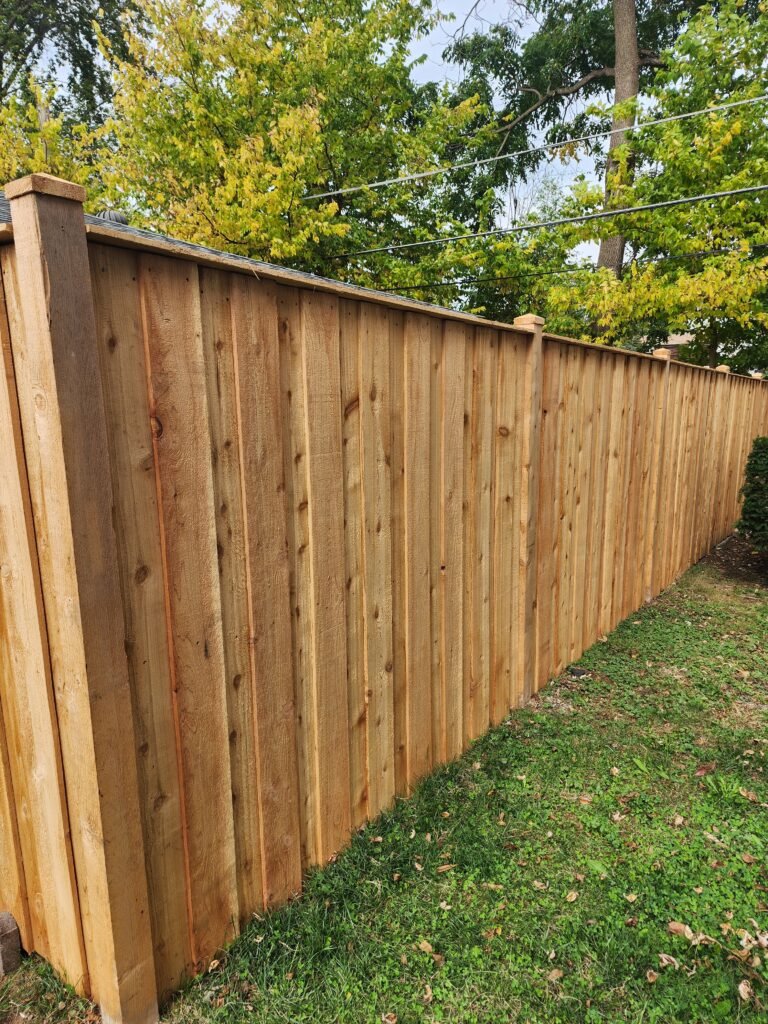
The lumber you choose can change the total noticeably. Current Chicago-area estimates put common fence woods at roughly $1 to $14 per linear foot for materials, with cedar and other species falling at different points in that range.
Pressure-treated pine is a common pick when keeping the upfront cost down matters. It can be treated to resist moisture, insects and decay, though it still needs proper maintenance and will weather over time.
Cedar is the other popular choice. It looks good without much help and is widely used for privacy fences around Chicago. Because wood prices move around, going from basic pressure-treated lumber to higher-end cedar can make a noticeable difference to the project total.
The boards you see are only part of the fence. A properly installed stockade fence also needs posts, concrete, rails, fasteners, the fence boards themselves, post holes, labor and careful alignment.
How well it’s installed has a big effect on how the fence holds up. Posts have to be positioned and secured properly, especially with the freeze-and-thaw cycles we get around Chicago. A fence that seems cheap at first can cost more later if posts start leaning, boards deteriorate or sections have to be rebuilt.
If you’re replacing an old fence, budget for taking it down and hauling it away. Chicago-area estimates put removal at about $3 to $5 per linear foot, depending on the fence type, its condition, access and disposal requirements. Removing 200 linear feet of old fence, for example, could add hundreds of dollars before any new fence goes in.
This matters most on older North Shore properties, where an existing fence may have been patched several times or have posts set in concrete.
You’ll need to plan for access too. A basic walk-through gate costs less than a large double gate for vehicles or lawn equipment, and the total goes up if you need:
One or more pedestrian gates
Double gates
Wide equipment gates
Custom gate sizes
Heavy-duty hinges
Latches
Automated gate operators
When you compare quotes, check whether gates are included in the price or listed separately.
Many North Shore properties have mature trees, gardens, retaining walls, narrow side yards and other things that make installation harder. An open backyard with easy access is usually quicker to work on than one where the crew has to get around:
Mature trees
Landscaping
Decks
Patios
Retaining walls
Sheds
Utility equipment
Narrow side yards
Sloped ground
Uneven or sloped ground can also add installation time, because the fence has to follow the grade and still look right and keep its privacy.
Before a new fence goes in, find out exactly where your property line is. An existing fence, sidewalk, driveway or your neighbor’s fence doesn’t necessarily mark the legal boundary. That’s especially worth checking in established North Shore neighborhoods, where older fences and landscaping often sit close to the lot line.
Northbrook allows fences to be built up to and on the property line, but the homeowner is responsible for making sure the fence isn’t on a neighbor’s property. Winnetka requires fences to stay within the property lines and advises homeowners not to use sidewalks, driveways, alleys, streets or neighboring fences to work out where the boundary is.
If you’re unsure where the line falls, a property survey can confirm it before installation.
Before you buy materials, check whether your village needs a permit — see our stockade fence permit guide.


 Trustindex verifies that the original source of the review is Google.
 Trustindex verifies that the original source of the review is Google.
 Trustindex verifies that the original source of the review is Google.
 Trustindex verifies that the original source of the review is Google.
 Trustindex verifies that the original source of the review is Google.
 Trustindex verifies that the original source of the review is Google.
 Trustindex verifies that the original source of the review is Google.
 Trustindex verifies that the original source of the review is Google.


